3.4.11

moscow vegetarian

lots of people mock London's food, i think unfairly. true, english food is disgusting, but there is so much choice that it is easy to avoid. You could probably try a different kind of cuisine every night for a month in London with out ever repeating yourself. yet, unfairly, the city still often comes second to other European capitals (Paris, Rome) when food gets brought up. I have been to many great restaurants in Rome, but i find that cities with good national cuisine tend to suffer from a lack of variety. try getting a good korean meal in Rome, or Eritrean dinner in Lisbon- good luck.
But alongside London, another city that often gets a bad culinary wrap is Moscow, which i find equally unfair and outdated. Sure, choice in 1995 was limited, but that is no longer the case. Furthermore, in a traditional country where you can probably count the vegetarians on one hand (ok i might be exaggerating- but only slightly), you can get an increasingly decent vegetarian selection, something that is seemingly near impossible in Madrid.
I found myself spending much of the past week in Moscow, by myself on business. I had lots of reports to write up and conference calls with out London office that i had to dial into rather late. So whist i did go out to treat myself to my favourite Georgian and Sushi favourites a few times, several times I simply ordered into my room, but even then i had exactly what i wanted, made exactly to my specifications- an it was delicious. my mother hated the Soviet Union for a number of (obvious) reasons, but one of her chief gripes was the lack of "salad," it bothered her immensely that even when something called "salad" could be located, it normally consisted of peas, potatoes and mayonnaise, without lettuce ever making an appearance. so I took the picture here of a Moscow salad for her- no lettuce shortages these days.

19.3.11

the last flight out

air traffic commutes, i imagine like all commutes, fluctuates depending on the day, and the time of day. Monday morning at Heathrow is a nightmare, by 7am there are massive queues all over the place, and even though i have a priority pass, i don’t bother getting it out, as clearly everyone else has one as well. the place is clogged with people returning home after long weekends in london, commuters who live in london but work elsewhere and people like myself, kicking the week off with a round of meetings somewhere abroad. by the time i reach the executive lounge, it is high rush hour, there are hardly any seats and the staff are struggling to keep the free breakfast items stocked up. but there are other times where the situation is much the reverse. there is something rather spookily cool, yet also melancholy about waiting for the last flight of the day, which is what i find myself doing now. it is late, i am in Stuttgart airport. almost all the flights have gone, the shops have closed and so have all the lounges except the British Airways one- but there are only 2 of us in it. The night flight to london is the last anyway, but tonight it is delayed and no one is sure when we will actually even board. so i sit and pour myself some more wine and enjoy my kindle. when i get bored i go for a stroll through the totally empty terminal, staring at all the empty gates and dark shops. lots of people i work with hate these moments, feeling that such times are digging into their personal time. i feel the opposite, i would take this any day over a 8-6 stint in an office.

17.3.11

random Germany


like the UK, Germany stands out in Europe for it’s apparent habit of sticking large multinational corporates in totally random places. Just as in the UK where you find yourself constantly having to go to Leeds or Liverpool to see a major company, so today in Germany I find myself in places like Karlsruhe and Stuttgart.

My feelings on Germany have been well documented already on this blog. I cant stand the place. Only Berlin is mildly tolerable, the rest makes my skin crawl. Some people have tried to suggest that it is wartime era prejudice inherited from my father. it isnt. there is simply far too much law and order in this place for me to be able to function. it is too clean and too organised and it all makes me want to scream. i also feel lost in the absence of a proper metropolis. Germany has no really great cities. Berlin is the best, but even it is quite provincial, and the rest is infinitely more so. the companies i deal with are remarkably inward looking, they have no clue what is going on elsewhere in Europe as they have no real growth ambitions, they are happy to stick in the german market. in fact, compared to the other places i have been going to lately, people here seem almost indecently happy, if not smug! they don’t moan about the economy! they talk of buying new cars! Downtown Stuttgart is packed with shops and shopping centres, and even on a random monday afternoon they all seem busy, there is just something unbearably successful about this place that drives me mad! there is too much self contentment- it just isnt right! i start to panic, there can only be one cure- i book a ticket to moscow for this weekend

get me out of this stinking fresh air!

16.3.11

inspiration

H has a summer house near the sea. I stayed there some years ago when I went to visit in June. But the place has much changed since, in fact I would argue that it has ceased being a flat and converted into what I have deemed an ethnographic museum.

As H reminds me, we are not normal. we are like a pair of vampires, seemingly living within normal society and yet we never belong to it. H is one of the few people with whom I don’t constantly feel like a freak, but that says more about me than the rest of the world. We meet one of H's friends, a nice local boy who is highly educated and has a well paid job at a time when much of the country is unemployed. yet, he has no passport. he thinks we are utterly mad for living the way we do, in and out of airports and suitcase. he cant imagine that this is simply how we are, how we were raised. I am sure that he cannot believe that sane people sit around and plot ways into puntland or holidays in Juba, when sane people are going to the beach. but some of us do. H has been to more places than I have, every country in the word to be exact, and unlike me, he has taken to collecting kitsh souvenirs. I almost never buy anything anywhere I go. I take loads of photographs, I think mainly out of an irrational paranoia that if I don’t photograph everything I will surely forget it all, but I have never been much of a shopper. there never seemed any point most souvenirs are rubbish and look tacky the moment you get home. H however has taken a different approach, he has chosen to celebrate the sheer tackiness of such souvenirs, sticking them all over his flat, with the most ridiculous ones given prominence, and the result is sheer genius, It Is truly an ethnographic display, capturing the most diverse and random spots on the planet. It is Inspiring. so much so that It makes me want to go out and buy the most stereotypic Item I can get my hands on. amazing stuff.

15.3.11

Naphlion


I rarely get to go on road trips. I hardly know anyone in the uk with a driving license, and when I am abroad I rarely have time for a leisurely road excursion, unless it is to go see clients in provincial scotland, but that is never fun and therefore hardly counts.

So I am delighted when H suggests a road trip to Naphlion, which used to be the capital city of greece for a brief period after independence. the town is about 2 hours drive from Athens, and the road trip is loads of fun, although i am continually baffled by the endless toll blocks, but maybe that is just because i am not used to driving? we stop briefly at the Corinth Canal, the marker telling us we are crossing into the Peloponnese. I never suffer from vertigo, but standing on the bridge looking down 52 metres, i have to say i fely a bit dizzy. i think it is partly because the canal is so narrow that it seems even deeper and more mind boggling than it would otherwise…or because the railings are totally flimsy and it would be all to easy to jump over the side? so easy in fact that there are signs everywhere advertising bungee jumping, which we don’t go for. the road trip then continues after a pit stop to refuel. thanks to the events being orchestrated by Colonel Ghadafi on the other side of the Mediterranean, the prices are shockingly high, even compared to Britain (€1.70!!!) but the money as worth it as the roads take us along paths I would otherwise never have trodden and allows me to see sights I otherwise would never have seen. as we approach Naphlion, I am struck by how much the scenery resembles that of parts of the former Yugoslavia, reminding me that I am actually back in the Balkans, despite Greece normally successful bid to remove itself from that unfortunately tainted geographic term.

Naphlion is adorable and I love it. H assures me all the people in the Peloponnese are short and ugly, and i have to admit he is not wrong, compared to Athens there is indeed a genetic difference that is quite striking given the relatively small distance between the two. but Naphlion couldn’t be lovelier, and the locals certainly know how to enjoy themselves. Despite the constant talk of apocalyptic economic meltdown, everyone is out in the streets. it is a religious holiday- Lent is about to begin, and there is music in the town square. Yet people are not just standing and listening to the music- all the cafés are packed, so that H and I can barely find a seat by the water, and the restaurants on the main culinary drag are so stuffed that we end up going back to the main square as there is literally no where else we could get a seat. Despite the crisis, people are clearly still going out. Furthermore, this restaurant filling can hardly be credited to tourism- it is the dead season, foreigners don’t go to Naphlion that often anyway, and I am quite certain i am the only foreigner in town, which is made obvious by the frequent stares i get from curious locals wondering what strange rock i must have crawled out from under. the wait to eat is long, but it proves to be every bit worth it as the food is divine. One of the things i like about Greece (and, lord strike me down, Turkey) is that although the national food consists mainly of meat, there is always so much food that even as a strange vegetarian i never go hungry, unlike in Spain. H and I order several plates, including another excellent greek salad, fava, tzeziki, and fried potatoes. By the time we have finished eating i feel i can barely move. "on mange bien en greece" H assures me. How very true that is!

13.3.11

lisbon


why has it been so long since I was last here? I love this city! I have been here a few times before, visiting Lemurana, but since she relocated to england, I havent returned even once. as a result, I forgot just how much I like lisbon. I think it is one of the most manageable and most attractive cities in europe. what always sticks In my mind about it the most (besides the pasteis de belem) is the sun. they actually have proper sun here, the kind that makes me squint even in the winter. that kind of sun makes me feel warm even when the temperature is not particularly warm, and it makes me feel happy even as i have to sit and endure hideously dull meetings on obscure topics. but beyond the sun are the cute (and i don’t mean to sound patronising with that word, i am totally and unusually genuine here) streets and trams. i love plopping myself on the 28 and riding around aimlessly staring out the window, it costs nothing but i find it a completely satisfying excursion. i continue to ham up the tourist thing by going and eating pastries with espressos in every neighbourhood i find myself in. i cant help it, they just always seem to be calling me! finally, i end up shopping. the shops here, even the big Iberian chains, are way cheaper than they are in england, even though portugal technically has a higher VAT as a result of its extremely difficult financial situation. by the end of the day i have to force myself to stop as they simply will not let me back on the plane it i have anything more with me. i have bought dresses and jumpers and find myself ogling bedsheets when I realise I need to exercise SOME self control here. but I think there is really a quite simple solution- I clearly just need to come to lisbon more often.

12.3.11

Mediterranean malaise

Part by luck and part by my own design, i end up in 4 Mediterranean countries in 2 weeks, Italy, Spain, Portugal and Greece. the mood of impending disaster is identical everywhere, although no one believes me when i say that, every person i talk to is certain that their country really does have it the worst. Greeks tell me they have it worst as they needed a bail out. Portuguese clients assure me that actually they have the worst lot, since they have not even got a bail out yet, but will surely need one and it will be on worse terms since countries like Greece have already been bailed out. Italians moan that even their prime minister is facing criminal charges and the Spaniards assure me they will be bankrupt within a year. in portugal i meet an old friend i havent seen in nearly a decade. he has launched a new career for himself, providing people with advise on bad credit- when to declare bankruptcy etc. it is clearly a growth industry. everywhere you go there is a lurking sense of hysteria, like everyone has spotted the package and now they are all just waiting for the bomb to explode, hoping it doesn’t kill them.

the economic figures for all of these countries is grim. all are facing unprecedented cuts, all are struggling with epic numbers of unemployed, especially unemployed youth. all have been hit by the implosion of the construction boom and the fall in tourism. in every country, the crisis is the first topic of conversation. i walk into a spanish boardroom, introduce myself, and the first question a vice president asks me is "what do you think of our collapse?"

what I find odd, however, is that in all four counties, this tremendous crisis is not immediately obvious, in fact quite the contrary. people assure me that if I look carefully at local peoples faces, I will see the crisis written on them. my portuguese friend assures me that people just look sadder than before, my Italian contacts say the same. but what strikes me, with my outsider perspective, is that the cafés and bars are surprisingly full and that people seem to be out in the streets enjoying themselves. on a saturday night in athens, trendy neighbourhoods have filled bars and restaurants with cool looking young people enjoying themselves. on a sunday afternoon In a small greek town some hours from the capital, the main square is full and along the spectacular waterfront my friend and I struggle to find seats amongst the local crowds. In milan the shopping centres are full. I wander into abercrombie and fitch (of all places) and the queue to pay must have been at least 30 minutes long. In diesal I was going to try on jeans, but the queue to the changing room was too long and I needed to get back to the airport. I managed to get some shopping done in lisbon and in madrid, but even there the shops were full. In athens, my friend's father assures me it would take an awful lot to keep the greeks from going out. so it seems across the Mediterranean. I hope it stays that way.

11.3.11

milan


Milan isnt Rome. it lacks the capital's beauty and mild climate. actually, when i arrive at Malpensa airport, the temperature is 5 degrees lower than in london, and it is raining heavily. that said, i still think Milan generally gets a bad rap unfairly. sure, it is probably the ugliest city in Italy, but that is judging it against a high standard. Despite its lack of typically Italian charm, it is still nicer than many of Europe's cities. the shopping is more than decent and the food is certainly tolerable. most of the city is grim and industrial, but the core around the Duomo is lively and pretty enough. it also does a good job, more so than Rome, of catering to business travellers. there is a good selection of hotels and transport and cabs are efficient- at least by Italian standards. Inside the office though, things are no different than anywhere else in the country. I get taken for excellent cups of coffee over delicious biscuits, and treated to endless tales of woes: the economy is a disaster, Libya has created a disaster, Berlusconi is a disaster, the company budget is a disaster….another coffee? trying to get any work done is turned into an epic task, with contracts taking months to sign as 15 people seem to be employed to pick apart every piece of paper that comes their way, and another 15 are needed to stamp those same papers, but everyone you need is out of the office the moment you need them and no one knows where they might be. it is all most maddening, although made somewhat forgivable by the excellent coffee and biscuits. were it not for the culinary delights, i think this place would succeed in driving me absolutely mad.

10.3.11

spain

I can anticipate the answer, but hopefully and hungrily I decide to try anyway: “do you have anything vegetarian?” the answer is as i imagined: "of course not senora." at least this waiter is honest, half the time they claim they do, and then bring some salad or tortilla covered in tuna or ham. I am so hungry i feel light headed. i havent had anything since last night's Yo Sushi special in heathrow's terminal 3. there was no time for breakfast in the hotel, my meetings ran through lunch, and all i want now is an early dinner, as i know i will not get anything on my Iberia flight tonight. but i cant find anything to eat.

I love spain. i love working in spain. the companies are, generally, well organised and relatively creative. the people are honest seeming and friendly. it is late February and the temperature in the afternoon hits 23 degrees. it is sunny and i sit outside drinking an espresso between meetings. i would be perfectly content here- if only there was something i could eat! it is not a sheer produce problem- i have gone to the supermarket here and stalked up on supplies that i always buy in spain as they are more expensive in england: my favourite brand of pasta that you can get in italy and spain but not in Britain, dulce de leche imported from argentina, coffee, manchego cheese. the supermarket is well supplied, but i don’t have a kitchen here in spain and i am hungry now. there is nothing ready made available.

It isnt a language problem either, i speak spanish and have explained in great detail to several people what vegetarianism is, but these explanations never get me anywhere. back in barajas, i try to order a salad. i specify that i am talking about lettuce and tomatoes, nothing else. the waiter nods understandingly, and brings me a plate covered in tuna. I try to scrape the tuna away and eat the lettuce as I am hungry, but I guess I got some of the juice anyway, as I end up throwing it all back up again in Barajas airport's toilets. grim. I am going to have to start packing bags of sandwiches for future trips here i think.

3.3.11

some socialist kitsch

ok, i know it is 5 days too early, but i guess my dad didnt want to leave things to chance and over rely on dodgy postal services. so today i got in the post this lovely postcard. i couldnt believe it and immediately went to show all the ex soviets in my building (um, all 2 of them). living in western europe, it is of course easy to forget about holidays like the 8th of march that just dont exist elsewhere, but seeing a postcard like this roared me right back to moscow and 8ovo marta celebrations.
in general, i love the post card, it is just such an amazing artefact of a world long gone, with a russian woman standing in the middle of beautiful international solidarity with her african and asian sisters. the back of the postcard claims it was printed in 1977, and sold for 2 kopeck. incredible.

13.2.11

Scotland


Every time I come here it astonishes me once again how incredibly bleak this country is. Over the course of the past year I made a dozen trips up here. The highest temperature I ever observed in Aberdeen was 12, and that was in July. The hotel still had the heat on. Many of my travels take me to small , random provincial cities (Perth, Stirling, Inverurie) that always seem to require l

engthy travel for often very brief meetings. One of the frustrating things about provincial Scotland is that you always need a cab to get around. The trains don’t always go to all the places, and even if they do, once you get there, there is no public transport to get around, certainly not to industrial states on the outskirts of towns. going over my expenses this evening, I calculate I have spent over 150 pounds on cab fares, and that is fairly typical for a day trip to Scotland. Add on my food and drink expenses and it has been a pricey day. The other reason for needing to take cabs is that the weather makes other forms of transit unreliable. In my year of traveling here, I have had every sort of natural

disaster strike (Icelandic ash clouds, fog, blizzards, torrential rain etc) and every time the last transport to collapse has been the cabbies. So it was today. I left London at 5am and it was 13 degrees. By the time I landed in Edinburgh it was pouring rain and 1 degree. I went to meet a friend in the centre for a coffee. By the time I got to Waverley, it was snowing. In late morning I got a train to Perth, and by Haymarket it was a blizzard. I managed to get to Perth, but all the trains back were cancelled, yet for £70 someone was willing to drive me. Predictably, by the time I got back to Edinburgh airport, it was sunny and there was no sign they had had snow at all- the typically Scottish four seasons in one day. As one of the cab drivers put it, Scotland has unbeatable scenery and natural beauty, but you cant do anything about the grim weather.

But it is not only the weather that is grim. Waiting for meetings, I kill hours in desolate pubs, serving dishes I cant even recognize. I sit, waiting and watching. I watch people getting hammered at 11am, mothers feeding fried pizza and chips to their kids for lunch, fighting by 3pm, bored staff, and overweight, pasty faced people of all ages. It is grim. my meetings tend to be repetitive, the questions variations of the same. Then I always end up back at the same place- Edinburgh airport. After a client lunch that (regardless of the client) has generally made my normally tolerant arteries clench up, I always head for the Yo sushi bar. I am not generally a Yo sushi fan,

but after a day of fried mars bars, the thought of cucumber Maki seems appealing. Afterwards I check the board, find my flight slightly delayed, wander past the Rosetta stone stand and marvel all the languages I wish I spoke, then flop down in a booth in the pub across from gates 10 and 11 and wait for my flight. Or I wander into the BA lounge and look for some vaguely readable publication, which normally ends up with me flipping through the Scotsman for 10 minutes, ordering a wine and waiting for my flight. I check my email. I got over a power point. I make some phone calls. I sip my wine. Another day done.

12.2.11

if only every country was like Barbados


After achieving independence, many former colonies of European empires have struggled to shake of the negative legacy of colonialism and prosper as independent states, and this is as true in the Caribbean as in several other parts of the world. It is not, however, true of Barbados, which can claim easily one of the highest standard of living in the Western Hemisphere. it is indeed an amazing little country, not dissimilar from Bermuda in its prosperous and pleasant lifestyle. I find myself chatting to a local driver about driving in Moscow and traffic "laws." It soon becomes clear that this guy has no idea what a bribe is, he simply doesnt know what i am talking about. once i finally get the idea across, he looks appalled and assures me such things would never happen in Barbados. Other than perhaps a bit of bankers and white collar crime, it is a safe and law abiding place. the locals are helpful and friendly, and hotel is so incredible that we wouldnt have to leave it if we didnt want to, but of course, we do. This is an island with serious history and sites. There is a beautiful botanical garden to explore, and St Nicholas Abbey, one of only three Jacobean manor houses in the Western Hemisphere (my fathers swears to have taken me to Bacon's Castle, one of the others, but i have no memory of it!). St Nicholas's Abbey was a sugar plantation, which now produces its own very smooth but very strong rum. It has all the necessary characteristics of a grand old house with its
curved Dutch gables, chimney stacks, coral stone finials, and great rooms filled with fine antiques and china, as well as an amazing retro radio and some old editions of the Telegraph. but my favourite part was after the rum tasting when there is a short film of the island made by British travellers in the 1930s. what is amazing about the video is its sheer amateur nature. It wasnt meant to be shown publicly, and simply shows glimpses of every day life in Barbados, and people going about their work, crafting wagon wheels and so on. when travelling it is easy to take photographs or write blog entries that highlight the noteworthy, the incredible, or the interesting aspects of a place that is different to what one knows. but this short clip captures the everyday, and as a result seemingly transports you back into to time with it. incredible.

11.2.11

St Lucia: into the wild


it seems hard to believe that i didnt really know how to ride a bike until 2008. friends had sort of shown me when i was a kid, and other tried once in Estonia in about 2003- but biking was never something i was comfortable with until my previous employer decided to participate in the UK government's cycle scheme. We were all called into the staff room and informed that the company was dedicated to fulfilling its "corporate responsibility" and being "green" and as a result had decided to heavily subsidise all members of staff who would agree to ride bikes to work. since it worked out being practically free, i signed up on the spot and 2 or 3 weeks later was issued with a cute red brompton. the hard part came next when i had to figure out what to actually do with it. Learning to ride a bike is probably never easy, but i am sure that London traffic didnt help. but i got better, and i now never take public transport unless i am going really far or have tons of suitcases with me. so, perhaps mistakenly, i like to think of myself as a cyclist, although in reality my cycle experiences are rather limited. when i found out i would be going to St Lucia, someone told me that it was possible to cycle through the rainforest there, and i was immediately intrigued. Sure enough, you can actually rent bikes there cheaply and easily and go off on your own through the rainforest, so i persuaded a girl about my age from the ship to join me, and off we went. I was amazed that the rental bikes were of top quality- i am used to riding a Brompton, so getting on a massive full suspension off road bike was initially baffling, but soon i felt as though i was biking on air. Riding was a pleasure, not effort, even going over rocks and through mud. but even that feeling of lightness could not compare to the feeling i had getting out on the road, looking ahead, and seeing nothing but endless layers of trees and green space. i have never seen nature so raw before. the road, which at times dwindled into a muddy single file path, twisted and turned through the forest, at times winding along the edge of terrifying ravines. whilst on the bike, i would be too scared to look down, but a few times i dismounted and simply stared at the ravines filled with some of the world's most lush vegetation. it was breathtaking.
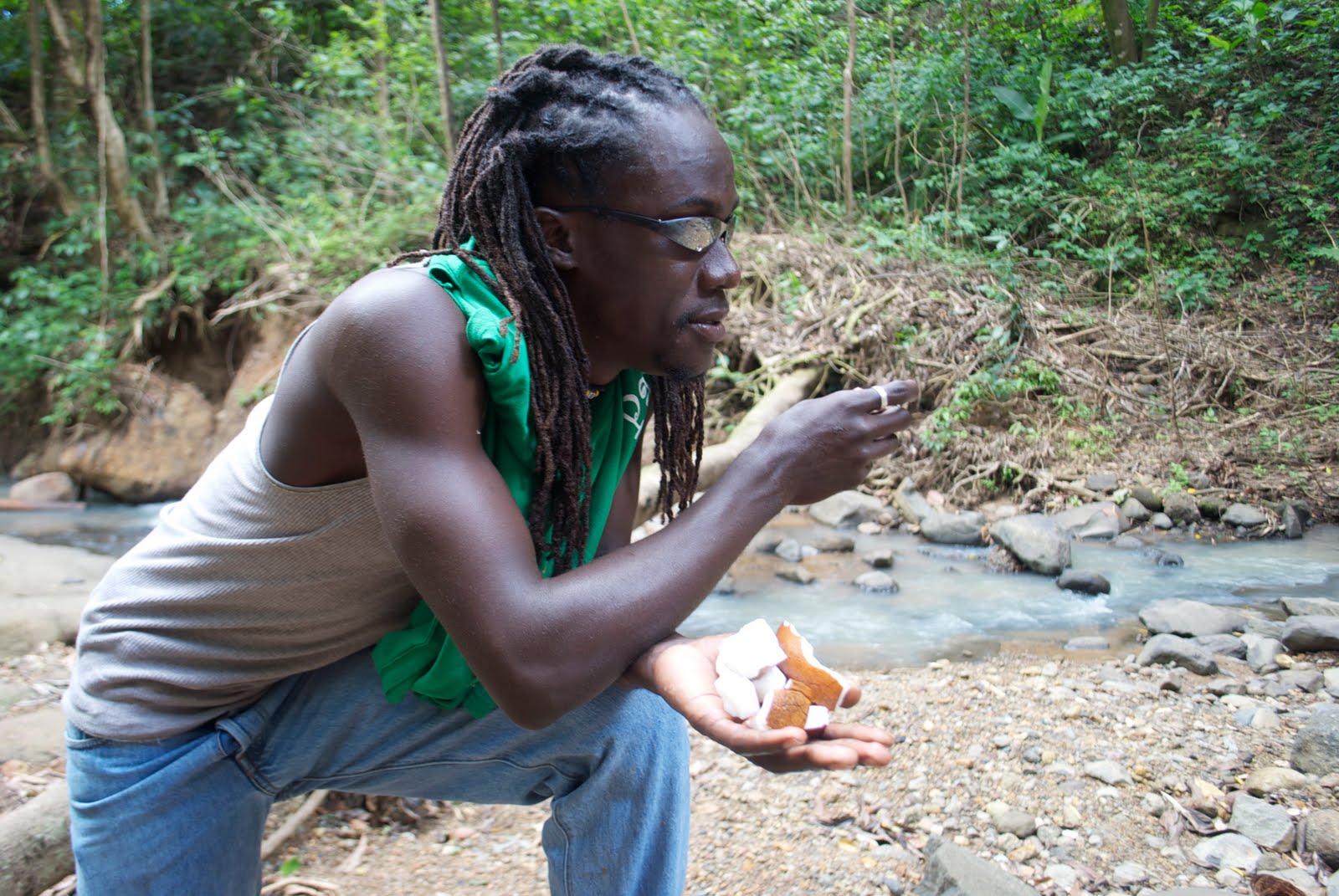
then, suddenly, there was a waterfall. i jumped into it, then met up with a bunch of locals who showed us how to smash coconuts and eat them...and there we all were, sitting by a waterfall, eating coconuts and staring at the vegetation. It was all most surreal, but tremendous. it reminded me why i travel.

10.2.11

Jimmy of Bequia


our travels around the Caribbean bring us to many small and random places. One of the smaller, even by small Caribbean island standards, is Bequia, one of the Grenadines. It has a population of just over 4,000 living on seven square miles of land. The inhabitants are an improbable mixture of Black, Scottish and Indian- although no one is able to explain to me fully the peculiarly large Scottish representation. For a long time the place considered to be not worth colonising, and through the 17th century, it was populated by Carib and Arawak Indians, as well as occasional runaway slaves and shipwrecked peoples- supposedly a few Portuguese and Dutch slave ships on route to Sint Eustatius from West Africa reportedly shipwrecked on the reefs. In the 18th century, settlers arrived, and certain sectors, such as sugar, took off.
today, it is where you would go to hide from the world (if you cant afford nearby Mustique). Most of the beaches you can only get to by "water taxi," which is basically a random guy with a boat who stops and gives you a ride. Once you get to the beach, unless is right next to Port Elizabeth and there is a massive cruise ship docked nearby, chances are you might be just about the only person there, for Bequia is a pretty quite place. My father and I find ourselves in this position- we arrive by water taxi on a nearly deserted beach...but even it has something claiming to be a "bar," and as the sun reaches its mid day peak, my father seeks refuge in it. sure enough, a guy appears out of no where and manages to serve a nice cold local beer, while i go and get into the immaculate water. Later we take a walk through Port Elizabeth, which is the main city ("settlement" would be the better word really) on the island, it consists of only a few streets. i make the mistake of leaving my father alone for a few moments whilst changing camera lenses. By the time i got the right lens on and looked for him- he was gone. fortunately an old white man with a cane can only escape so far in a place like Bequia- and i soon find him in deep conversation in an open air food market, where he has in under 2 minutes befriended all the vendors. By the time i spot him, he is able to tell me where the vegetables on the island come from, and how much they all cost. We sit down with Jimmy, the market owner to discuss the island. I have loads of questions about things, but Jimmy is keen to make it clear he is not some provincial island bumpkin, and is soon giving us his views on Obama's foreign policy. it is truly amazing the things that my fathers price comparison obsession can lead to....

9.2.11

Antigua, Barbuda, God and Cricket


i have to confess that i arrived on Antigua and Barbuda with very few preconceptions. it was sort of an afterthought addition to the itinerary. it was on the way, so why not stop, i think went the logic. i suppose that is the way to see it. i certainly would never make it a main destination, of course it has beautiful beaches, but then so does every island in this region. St Johns, the main city, hasnt got much to it, and even the nature doesnt have the sort of jaw dropping attraction that other nearby islands can offer. furthermore, there are clear pockets of serious poverty that my eyes need readjusting to after the obscene wealth of St Barth.
but the island has one redeeming feature, and that is friendly people. Actually, the people I have encountered across the region have generally been open and friendly, but perhaps the lack of other excitement here draws me to them more? or perhaps i just have more time to talk to them, as we have relaxed itinerary? I am actually not sure, but several times my father and i find ourselves striking up conversation with interesting characters. the locals, even the ones who look like teenage hooligans with their trousers half way down their asses in imitation of North American rappers, are polite and well spoken. on an uneven street in St Johns, my father struggles with his cane, and seeing a group of young teenage guys waiting for him to move out of the way, tries to hurry his pace. The boys see this and immediately step up, helping him and saying "easy there pops" and "slow down pops, we're not in any hurry." another time, in the dockyards, he got tired and i left him sitting on a bench under the tree whilst i went along to see the rest of the sights. I came back 30 minutes or so later to find him in the same place, drinking his second or third pint with some local ladies in their 60s. they had just seen him sitting alone and struck up conversation. several people we talk to are very happy to talk about their island and their culture, which seems to pivot around two key topics: God and cricket. this is a God fearing country. People go to church here. In fact, that is precisely what they do on Sundays: they get up and go to church for hours. the rest of the day is spent with the family in a close circle, eating and taking care of the kids in the extended family and so on. all that is of course, utterly foreign to me, but it is the way of life here. it is a deeply religious country where such matters are not for sarcasm or jest as they are in Europe, and even young guys who look like thugs seem convinced by the power of the almighty. But if anything can come close to God in the hearts of the locals, it appears to be that most colonial of English sports- Cricket. i have never understood why anyone would find this game of any interest, to be honest it bores me to tears, but its power is felt throughout the whole Ex-British island area. Everyone i meet bombards me with questions about so and so who played for Nottingham or Leicester. i politely nod and pretend i have a clue what they are talking about when in fact i know nothing on the subject. As the afternoon approaches, the empty fields in the country fill with youths, all dressed in nice colonial cricket whites, batting their hearts out. people come and watch.
Antigua and Barbuda might not have some of the eye catching exotic sights of the other nearby islands, but it is in its own way most exotic, as the local customs are so familiar, and yet so utterly different to my own. and it is in these moments that i am indeed glad we made this stop on our journey.

8.2.11

Paradise for the few


I would never want to live there, but I really don’t see how anyone could not like, or at least envy St Barth. the place is truly a paradise….provided of course you have obscene amounts of money. the island is incredibly small- some eight hilly square miles are inhabited by only about 8,000 people. from every corner, the view is tremendous. the water is a perfect shade of blue. you can swim out until your feet can no longer touch the sea floor- but you can still look down and see them perfectly. the sand is incredibly soft, so that you can walk comfortably on it barefoot for ages, with out feeling and pricks of jabs from rocks or irregularities. the beaches are massive and everywhere, but they do not feel overcrowded. the cafés and restaurants are all well designed and well supplied. they are filled with beautiful people, and they are priced accordingly. in many, a relatively small lunch can easily set you back €200 if you include alcohol. The one restaurant that is famous for not raising its prices is Le Select, just in the centre of Gustavia, but people tell me it has nonetheless achieved inflation by shrinking the portions, but then it can get away with what it wishes, not only does it have the exclusive privilege of being located in St Barth, it is also supposedly the bar where Jimmy Buffett donated the "cheeseburger in paradise" name in exchange for a lifetime of free beer. Looking at the scenery from the restaurant's terrace, it is easy to envision Buffett's world, not only in that song, but throughout his collected works:

Nibblin' on sponge cake,


watchin' the sun bake;


All of those tourists covered with oil.


Strummin' my six string on my front porch swing.


Smell those shrimp--


They're beginnin' to boil.

many of the regions islands are too edgy to absorb such utopian lyrics, but they can fit in St Barth just as easily as those of part-time celebrity resident Johnny Halliday, whose favourite local dining haunts are also well known. but St Barth is also a strange mix. On the one hand, it is cosmopolitan, filled with luxury European shops ranging from Gucci to Chanel. waiting for my father and my uncle by a parking lot, i wander into a random shop, where i discover a bikini would cost me..€300. the island is filled with celebrities, we pass the houses of Johnny and Laeticia, Eric Clapton and Roman Abramovich, as well as restaurants where the cost to make a RESERVATION is around €4,800 PER PERSON. yet at the same time, there are serious elements of the provincial French mentality captured so perfectly by Marcel Pagnol's classic novels La Gloire de mon père/ Le Château de ma mere: that of provincial France. The island was first settled by French colonists in the 17th century, but until the 1970s, the population of the island was only around 2,500. Until the 20th century, the islands were relatively poor and remote, dependant on salt and limited agriculture for survival. With the influx of the wealthy, the population has now ballooned to 8,000, but those pre 1970s families represent a world somewhat removed from the celebrity scene. I go to the house of a woman who represents the 10th generation of her family in St Barth. Hers is a small world that until her/my generation consisted of arranged marriages (largely for property purposes) and byzantine laws of who spoke to whom and went where. But she doesnt live in isolation from her new neighbours- on a walk we pass and are greeted by an older woman dressed in white, I ask if it is another local, but it turns out to be a friend of Jacques Chirac. Over the hill is Johnnys house, and yet in the little villages by the sea, old French colonial ladies fan themselves on porches. I wonder how long it will stay like this?

chasing abramovich

The concept of Russian luxury tourists really tickles my father. Having spent much of the 90s and noughties in Russia, and witnessed the emergence of the oligarchs when I was in my 20s, it surprises me less. By my fathers world is profoundly a Soviet one, formed and stuck in an area when the few Russia tourists you saw abroad were party officials or defectors. Even now, 20 years after the collapse of the Soviet Union, he still has difficulty accepting how things have changed. In the early 1990s, as we would badly dressed Russian tourists in places like Helsinki with their dated clothes, shoddy make up and dodgy hair colours, my dad would marvel that such things had become possible, that people were able to travel all of a sudden to “Western” Europe. But at least he could imagine that degree of change. The new kind of Russian traveler, however, he cannot comprehend, even though we keep coming across his long and well heeled shadow here in the Caribbean. As noted above, Richard Branson’s private Necker Island, where rooms start at $54,000 per night has a bilingual website- in English and Russian. that gives some clue as to the Russian presence here. But unlike in other places, like Thailand or Bali where drunk Russians are audible and visible everywhere, here they mysterious hidden, spoken about by locals in hushed terms. They are not the new found wealthy affording there recently possible excursion for some winter sun on a tropical beach- these ones here are the grotesquely over the top natural resource wealthy super elite. Their traces are everywhere, but they are rarely seen. We sail past Necker island, but see next to nothing other than lush vegetation and rooftops. In St Barths, my uncle and I go for a drive, and we pass a brand new football pitch so beautiful it is breath taking and my uncle pulls over so we can get out and have a look. Of course St Barths is rich and can afford all sorts of things, but it also has a population of only 8,000-hardly the numbers to support such a structure. We walk over and it is totally open to the public, but it is unlike any normal pitch. It is maintained like none I have seen, and every aspect reflects the tremendous attention to detail and care that obviously went into building it. my uncle investigates, striking up conversation with one of the numerous care takers, who tells us in reverent tones that the pitch had been built, for $1,300,000 no less, by Roman Abromovich as a gift to the island’s youth. Of course Abamovich has a home on the island (a massive one, taking up a chunk of a hill) where he spends some months of every year. The locals speak of him respectfully, more so than they do of some of their “native” ie francophone celebrities like Johnny Halliday and Laeticia. On another island I see a yacht like none I had ever seen before (and I have seen plenty!). it is both slightly ugly in a vaguely militaristic way, and stunningly beautiful at the same time. I set my telelense zoom to 300 to capture the ship’s details, send them to people who would know and find out some information. The ship is considered to be one of the worlds first “super yachts” and was designed by Norman Foster. I get sent a few images of the interior and it is nothing like I have ever seen on a ship before. I am later told it was being rented out by “a Russian billionaire.” Abramovich? Maybe not. He owns his own, and he is not Russia’s only billionaire by any stretch. News of Russian activity reaches me again in St Lucia where rumours of wealthy Russians arriving on yachts and paying ridiculous sums for guided tours through the rainforest surface, and on Barbados, where cab drivers tell of extravagant parties at the exclusive clubs and resorts. One cab driver proudly proclaims that Abramovich pays them a visit every year, just like Prince Harry. Such, it seems, is the life of Russia’s new aristocracy. My Soviet father shakes his head in disbelief at ever tale. “How did this happen? Where did they all come from?” he ponders as his world view is turned upside down. I am sure he is not the only one asking these questions.

7.2.11

British Virgin Islands


like many current and former British island colonies, BVI is a rather checkered place, or as Somerset Maugham put it, a sunny place for shady people. its GDP is dependant on two forces: tourism and offshore industries, chiefly offshore banking. every tax haven is going to attract certain dodgy types, and BVI has plenty. it has a statistically high GDP per capita, but the cost of living is high and the pockets of poverty noticeable. it also has a fairly intense drug trade, catering not only to wealthy local consumers, but to north american export audiences as well. "Our little slice of paradise" one woman describes it as to me. looking at the views i can see her point. nearly 60 islands, of which only 15 are really inhabited, and all of which have spectacular views and weather. Two are owned exclusively by Richard Branson, one of which he has converted into an exclusive resort where rooms start at $54,000 per night (the website is tellingly available in two languages, English and Russian). From Virgin Gorda I get a good view of this famous island and hear some stories of the supposed antics that go on there. but a few miles away, some people live in fairly basic dwellings, with unpaved dirt driveways and chickens running about in the yard. the houses are the same as you see in poor neighbourhoods across the ex-British Caribbean and the US south, small, normally one story with the exact same shaped windows shielded by white lace curtains, a dilapidated rocking chair on the small front porch, a round water sistine somewhere out the back, and maybe an outhouse too if it is really basic. a front room with carpeting, and behind it a kitchen where things are fried. in the shadow of Branson's Necker Island it seems an odd contrast.
but nonetheless, even for the relative poor, BVI is seen as a land of opportunity. I speak to one woman about my age, LaShonia, who moved 7 years ago to the island from Guyana. She estimates she will need to put in another 15 years or so of work before she will be able to settle there and get one of those small houses, but compared to life in Guyana it is all worth it. she assures me that even the relative have nots in BVI have enough. wandering down to the Rocks one afternoon, i found it hard to doubt her. after a short 15 minute climb down a trail, i find myself surrounded by breath taking beauty- perfect sea, perfect sand, all shaped by spectacular rock formations. indeed a slice of paradise.